
PRIUS α(Prius V, Prius +) Circuit impression | 中古車検索・中古車情報はGTNET
スポーツカー専門 GTNET
TOYOTA PRIUSα(Prius V, Prius +) Circuit impression.
Racing Driver Takayuki Aoki took the Prius α out to Central Circuit for a full impression.

Updated :July 21, 2011
The Prius alpha drives just like low height minivan. Top speed is the same as the Prius despite substantial cargo space improvements!
Takayuki Aoki took the brand new Prius α to Central Circuit for a driving impression. He took a look at the performance differences between the 5 and 7 passenger models.


●What was your first impression when driving the Prius α?
Today, we compared the Prius and Prius α and found that the characteristics were very different due to the 100 kg weight increase and the 80mm wheelbase of the Prius α. If I had to summarize the Prius α in a few words it would be "minivan style." The car exhibits mild understeer and the steering feel is very mild. However, this understeer is not a bad thing because the car will still turn with more steering input. Tight corners usually force drivers to add extra steering input and it is good to know that this car will make that turn during panic situations. The Prius α does not have the response or feel like a sports car, however, it drives and reacts like a minivan which properly matches the concept of the vehicle.
●What's the difference between the 5 and 7 passenger models?
Since the Prius α is 100-150 kg heavier than the Prius, I thought that acceleration would be greatly affected. However, once on the track, I felt no difference in acceleration whatsoever even in the straight. Although the manufacturer claims that the final gear ratio was adjusted to compensate for the increased weight, I believe that this is a very difficult thing to accomplish. I think that minor improvements throughout the car have added up. Lowering the final gear ratio usually forces the car to use the high RPM zone thereby making the car louder, but this Prius was surprisingly quieter than the current model. In addition, acceleration performance was almost identical between the 5 passenger nickel metal hydride battery and the 7 passenger lithium ion battery. The reason for this was because all the battery power was used up during the main straight-way and the vehicle ended up using only the engine at full throttle through the corners. I tried using extra braking to recharge the batteries and found that the lithium ion batteries seemed to charge a bit quicker. Since the lithium ion type batteries are said to be the next generation of efficient batteries, there may be a more distinct improvement in performance depending upon the testing procedures. The battery location is also different between the models but the 5 seater felt more balanced. The 7 passenger model with the battery in the center console felt a bit front heavy.
●How is the driving feel different from the Prius?
The electronic S-VSC and brake recharging system seems more advanced from the system in the 30 series Prius'. The 30 series Prius tested by GTNET was an early model where the recharging system would engage one beat after depressing the brake pedal. I remember it being more difficult to control. High-speed entries into corners would activate the S-VSC causing unnecessary gas pedal restriction… almost as if the car was saying, " Don't drive any faster!" I heard that the braking system had a new program installed after the US braking issue. I can confirm that the Prius α drives acts identical to the new version 30 series Prius'. The S-VSC and braking system feel very natural and braking control is improved. I felt that many of the former mechanical annoyances had been eliminated. It doesn't handle like a sports car, but is a predictable and stable "transportation car." One drawback is that the S-VSC system cannot be turned OFF so it activates in ALL corners of the track. This was the same for both the Prius and Prius α.
●Which car would you choose personally?
If I purchased a Prius α I would choose the 7 passenger model. However, the 7 passenger model would be very cramped on long road trips and luggage space would be almost non-existent. I'd probably choose the cheapest 7 passenger model. The hybrid system for a minivan style car is a big lure. Although the batteries differ on the 5 and 7 passenger models, top speed and lap times did not differ much.
The lithium ion battery seemed to recharge a bit faster. Faster recharging means a more efficient hybrid system and I would base my purchase decision based on this fact. One drawback to the lithium system is that it is located in the center console of the vehicle causing the floor to be raised. I can only store a few CD's in this space. Gas mileage never went below 20 km/l and 10 full laps on the track barely used any fuel showing how fuel-efficient this car really is. I think anyone would be impressed.

GT Driver:Takayuki Aoki
Test Data
Date:July 6, 2011
Location:Central Circuit
Weather:Sunny Temp:32℃
Date:July 6, 2011
Location:Central Circuit
Weather:Sunny Temp:32℃
Sitting in the Prius alpha seats

| Row 1 | Head Clearance:About 17cm Feet Clearance:5cm clearance |
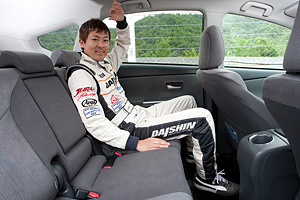
| Row 2 | Head Clearance:About 17 cm Feet Clearance:10cm clearance |
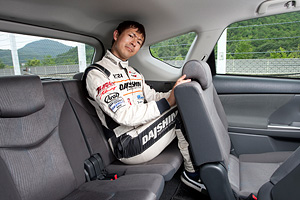
| Row 3 | Head Clearance: Limited Feet Clearance: Very limited |
Prius alpha Central Circuit Top Speed |
|
| Priusα(5 passenger) | 146km/h |
| Priusα(7 passenger) | 147km/h |
| Prius | 146km/h |
※Main straight |
|
PriusαCentral Circuit Best Lap |
|
| Priusα(5 passenger) | 1min 56.242 sec |
| Priusα(7 passenger) | 1min 56.960 sec |
| Prius | 1min 54.057 sec |

©2000-2024 GTNET株式会社